
Case study
What Fishbowl is, how it was built and tested, and what it gets wrong.
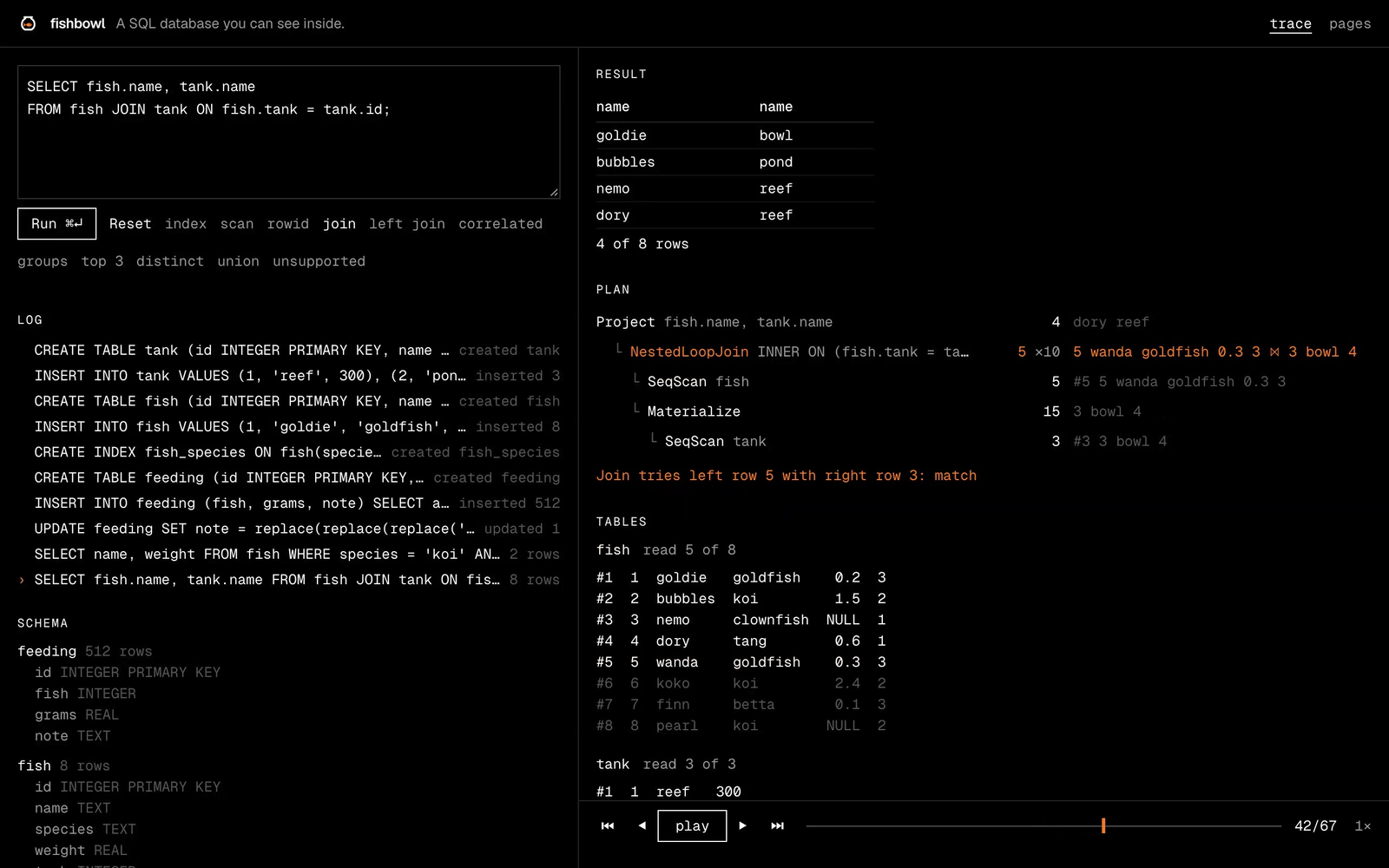
Fishbowl is a SQL database written from scratch in Rust. It runs natively and, compiled to WebAssembly, in a browser page that shows each query running row by row. Its correctness claim is a number: the share of SQLite's own sqllogictest suite it passes. This page covers how that number is produced, what else backs it, what was hard, and where the engine stops.
The goal
Build a database small enough to understand and complete enough to be measured against a real one. That meant three choices up front:
- Target SQLite's behavior. The sqllogictest expected answers are
SQLite's, so matching SQLite is what the pass rate measures. That includes
its odd parts: type affinity, NULL in
UNIQUE, left-to-right compound queries. - Write the hard parts, borrow the solved one. Parsing comes from the
sqlparsercrate. Planning, execution, the B-trees, the pager, the write-ahead log and recovery are Fishbowl's own. - Refuse rather than guess. SQL the engine does not support fails with
"not supported yet". A database that silently ignored an
ORDER BYwould return wrong answers; an error only costs pass rate.
Architecture
SQL text
  -> parse      sqlparser (SQLite dialect)
  -> plan       planner.rs: resolve names, choose access paths and join order
  -> execute    exec.rs: iterator model, one row at a time, rows counted per step
  -> store      storage/: pager and buffer pool, B+trees on 4 KiB pages,
write-ahead log, recovery| Part | Size | Notes |
|---|---|---|
Engine (crates/engine/src) | 11,500 lines of Rust | No unsafe (unsafe_code = "forbid") |
Engine tests (crates/engine/tests) | 3,100 lines | 137 #[test] functions across the workspace, plus property tests |
sqllogictest harness (crates/slt) | 1,200 lines | Own evaluator on the sqllogictest crate's parser |
Browser UI (web/) | 1,600 lines of TypeScript | React, Vite, Tailwind; a static site with no server |
Decisions that shaped the rest:
| Decision | Why |
|---|---|
| Iterator ("Volcano") execution | Each plan step pulls one row at a time from the step below. That maps directly onto the tree the UI draws, and each step can count its rows. |
| Tables are B+trees keyed by rowid, indexes are separate B-trees keyed by (values, rowid) | SQLite's layout. One generic B-tree serves both, so its splits, merges and property tests cover both. |
| Write-ahead log with no steal | Uncommitted pages never leave memory, so recovery only replays committed frames. The cost: one transaction must fit in RAM. |
| Storage behind a page-store trait | A real file natively, memory in the browser, and a simulated disk that loses power on purpose in the crash test. |
Row-level trace is an Option on the executor | An untraced query pays one check per row. A full corpus run with tracing forced on produced a byte-identical report. |
How correctness is proven
Five independent checks, each aimed at a different way to be wrong.
1. SQLite's sqllogictest suite
| Corpus | Files | Records run | Failed | Skipped | Pass rate |
|---|---|---|---|---|---|
| Full suite | 622 | 5,939,879 | 0 | 1,480,834 | 100.00% |
| 29-file sample | 29 | 129,348 | 0 | 14,153 | 100.00% |
Both are SQLite's sqllogictest at check-in ab599cbdd0 (2026-10-07). The
full suite is every test file in the repository at that check-in. Skipped
records are ones the file marks as not applying to SQLite (onlyif mysql and
the like); they count neither as run nor as passed. Every one of the
5,939,879 records run passes.
A pass rate is only worth quoting if it is hard to inflate. The rules:
- Pinned inputs. Fossil names a check-in by the SHA-1 of its manifest,
which lists every file's SHA-1.
scripts/pin-sqllogictest.shchecks that chain, then writes a SHA-256 manifest. The runner refuses to report if any file is missing or changed. - "Not supported yet" fails, even where the test expects an error. Only a
parse error, an unknown name or a broken constraint satisfies
statement error. - A panic fails one record, and a runaway query fails at a 20 million row budget. A budget fails the same way on every machine; a timeout would not.
- The report is deterministic. No timings, no machine details. Two full runs produce identical bytes, so a diff in the committed report always means a change in behavior. CI fails if the committed sample report does not match a fresh run.
- The harness is tested against itself: wrong values, wrong hashes, wrong column counts and unsorted rows must all fail.
- The README cannot drift. A test checks that the numbers quoted in the README and the results page match the generated reports.
The suite has a limit worth stating. Almost all of it is generated: 65% of
the records are random queries over small tables and 35% are generated index
tests. It never uses window functions, common table expressions,
ALTER TABLE or JSON. 100% means Fishbowl matches SQLite on the SQL this
suite uses, not on all of SQL.
2. Differential tests against sqlite3
crates/engine/tests/sqlite_differential.rs generates random scripts (writes,
indexed queries, joins, subqueries, compound queries, transactions, failing
statements) and runs each through Fishbowl and the real sqlite3 CLI, 3.54.0.
The two must agree on which statements fail and on every query's rows. It
runs 256 cases per cargo test. This test found most of the quirks below.
3. Property tests
- The B+tree must behave like Rust's
BTreeMapthrough up to 1,000 random inserts, replaces, deletes, commits and rollbacks, 256 cases with a three-page buffer pool (constant eviction) and 256 with the normal pool. After each case it checks key order, equal leaf depth, the leaf chain, that every page is used exactly once, and that a fresh pager reopening the files sees the same contents. - Random
INSERT,UPDATEandDELETEthrough SQL must match a plain list. - After every random write, each index must hold exactly one entry per row
(
integrity_check), and queries must return the same rows with and without indexes.
4. Mutation checks
A test that has never failed proves little, so bugs were planted on purpose:
- Three broken B-trees (a merge that forgets to relink leaves, a wrong separator after borrowing, a pager that drops dirty pages). Each failed 4 of the 5 B-tree tests.
- Eight bugs in the write-ahead log code. The crash test caught seven. The eighth, checksumming each frame alone instead of as a chain, cannot be seen under the disk model, because the log is never overwritten; SQLite keeps the chain as a second defense, and so does Fishbowl.
5. The crash test
A 30-statement workload runs on a simulated disk that records every write,
sync and truncate. The test cuts the power at each of those 178 points, then
rebuilds the disk several ways: unsynced writes lost, kept, torn at every
512-byte sector boundary, or randomly mixed. Each of 7,189 recoveries must
keep every transaction whose COMMIT returned, show no other change, and pass
integrity_check. 3,370 of them crash a second time during recovery.
Hard bugs and SQLite quirks
The harness misreported before the engine did. Three harness bugs would have skewed the number, in both directions:
select1.testandselect4.testhave nohash-thresholdline but write large results as "N values hashing to ...". The harness compared rows to that line and failed correct answers. SQLite's runner compares by hash whenever the expected line is a hash.- An
onlyif mssqlbefore ahaltwas dropped by the parser crate, so thehaltstopped the file for every engine and the condition leaked onto the next record. The harness now tracks conditions itself. - A
statement okrecord can hold two statements, which SQLite's runner passes tosqlite3_execand runs both. The harness ran neither. The full suite surfaced this one.
SQLite behavior the differential test found:
SELECT 1 UNION SELECT 1.0returns1.0: equal rows compare as one, and the right side replaces the left.INTERSECTandEXCEPTkeep the left's.- Compound operators run left to right with equal precedence, unlike standard
SQL, so the planner flattens
sqlparser's tree back into a list. UPDATE t SET a = a + 1on aUNIQUEcolumn holding 1, 2 and 3 fails, because constraints are checked row by row. The visiting order decides the outcome, so Fishbowl copies SQLite's: index order, unless the update changes that index, then rowid order.INSERT OR FAILkeeps the rows before a constraint failure, but a datatype mismatch still undoes everything.- Inside a transaction, SQLite keeps the partial work of a failed
INSERT OR REPLACE,OR IGNORE,OR FAILorOR ROLLBACK. Fishbowl undoes it. This is the one documented difference. - Affinity:
id = '5'is true for anINTEGERcolumn,+id = '5'is false, andCAST('1e3' AS INTEGER)is 1.
The last failures in the full suite turned up more:
max(DISTINCT a)is not the same asmax(a)when plain columns sit next to it. SQLite skips a repeated value without updating the row the plain columns come from, so witha= 1, 3, 3 the two pick different rows.NOT INDEXEDcannot be ignored as a hint. It makes SQLite read in rowid order, which changes whatgroup_concatreturns.- In triggers,
NEW.xhas no column affinity, despite the documentation, and SQLite visits the rows of anUPDATEwith triggers in rowid order.
The crash test was blind twice. Torn writes always left the log short, so recovery never read a torn frame; real file systems can grow a file before writing its data, so the disk model now does too. And a frame torn inside the zeros at the end of a page equals the whole frame, so the workload now fills a leaf about 90% with text.
Elsewhere: select5.test joins up to 64 tables and ran out of row budget
on every query until joins started from a filtered table and followed the join
conditions; it now runs in half a second. In the browser, two overlapping
WebAssembly init() calls created two module instances and corrupted the
engine; it now initializes once.
Performance
All on a 10-core Apple M4.
| Measure | Result |
|---|---|
| Full sqllogictest suite, 5.9 million records | about 40 s, 566 MB peak memory |
| 29-file sample | 1.8 s (7.8 s before the cost-based planner) |
Join of 100,000 orders with 10,000 customers, no ANALYZE | 0.68 s (52.9 s before the cost-based planner) |
| Correlated subquery over the same tables | 0.07 s (67 s before) |
| Insert 100,000 rows into an indexed table in a file | 1.09 s (sqlite3: 0.04 s) |
count(*) over those 100,000 rows, process start included | about 10 ms |
| Crash test, debug build | about 16 s |
| Browser download, gzipped | about 1 MB (921 KB of it the engine) |
The runner gives each file its own database and runs files on every core. Starting the largest files first cut the full run from 44.6 s to 33 s in back-to-back runs, because no long file is left running alone at the end.
The cost-based planner (M5) made the sample four times faster;
select4.test alone went from 9.7 s to 1.3 s. It costs time elsewhere. select5.test, with joins of up to 64 tables, went
from 0.22 s to 0.75 s, because the planner now searches join orders. The
full suite went from about 35 s to about 40 s across M5 and the fixes that
took it to 100%.
Fishbowl is about 27 times slower than SQLite at bulk inserts. The storage layer has not been tuned for speed yet. The suite stays fast because its tables are small, not because the engine is.
Known limits
- The planner is simpler than SQLite's. It copies SQLite's cost model
but not its
ORoptimization, skip-scan or automatic indexes. - Unsupported SQL: common table expressions, window functions,
ALTER TABLE, RIGHT and FULL joins,USING,NATURAL, savepoints,AUTOINCREMENT,WITHOUT ROWID, partial and expression indexes. Triggers work, but a trigger is replanned for every row it fires on, and a few forms (RAISE outside a SELECT, writing to a view from a trigger body) are rejected. - One connection per database file, with no file locking. One transaction's changed pages must fit in memory. The log is not checkpointed on close.
- The crash test trusts the operating system. It checks Fishbowl against a model of a disk, not the real file code against real power loss, and does not cover disks that lose synced data or flip bits.
- Speed, as above.
How it was built
The milestones ran in parallel lanes (SQL, storage, UI, proof), each on its own branch and merged when its tests passed. The pass rate after each merge, on the 29-file sample until M8:
| Milestone | Pass rate |
|---|---|
| M0: engine slice and harness | 11.90% |
| M1: sorting, grouping, aggregates, scalar functions | 31.04% |
| M3: pager and B+tree storage | 31.06% |
M4: indexes, PRIMARY KEY, UNIQUE | 84.31% |
| M2: joins, subqueries, compound queries, views | 99.89% |
| M6: transactions and crash recovery | 99.89% |
| M7: trace and page viewer | 99.89% |
| M5: cost-based planner, bit operators | 99.89% |
| M8: the full suite | 99.99% on 622 files |
| Last 452 failures: parser gaps, blobs, triggers | 100.00% on 622 files |
More detail: the milestones, the architecture, the harness notes and the learning notes, which explain each idea in plain language.